
How Attractive Am I? A Science-Backed Answer to Your Mirror Anxiety
Tara Lindqvist
6/10/2026

How Attractive Am I? A Science-Backed Answer to Your Mirror Anxiety
TL;DR:
- Attractiveness is ~40% features, ~60% grooming, angles, and how you show up — the latter is entirely learnable.
- The "mirror you" and the "camera you" are different people because of mirror bias and lens distortion; neither is how others see you.
- Confidence, clear skin, and good lighting beat genetic lottery every time — and they compound.
- Looksmaxxing obsession (mewing, canthal tilt hunting, face-shape fixation) often makes you less attractive because it broadcasts insecurity, not self-care.
- Take the quiz to ground your read on yourself in data instead of scrolling.
The Question You're Really Asking
When you type "how attractive am I" into a search bar at 2 AM, you're not really looking for an objective score. What you actually want is permission: permission to believe you're enough, permission to stop obsessing, or permission to accept that your self-image is warped. That's the wedge we're going to work in.
Here's the honest part: attractiveness is real and it's 90% learnable. You're likely stuck in one of two traps—either you're catastrophizing your actual appearance (brain trick called mirror anxiety), or you're hunting a single variable (jawline, eye shape, height) while ignoring the 12 things you can control.
The Mirror Lie: Why You Look Different in Photos
You are not the person in the mirror. This is science, not psychology.
The mere-exposure effect (Zajonc, 1968) says we prefer things we see frequently. You see yourself in a mirror every single day, usually in suboptimal lighting, at angles that flatten or exaggerate features. Your brain learned to love that version—even though it's horizontally flipped compared to how the world sees you. Everyone else sees your face 180 degrees reversed.
Add mirror distortion bias: if your mirror is even slightly curved (most are), or if you're standing at a normal distance, features toward the edges stretch. You also adjust your posture and expression in the mirror automatically—shoulders back, chin slightly up, a semi-smile. Photos catch you off-guard, tired, or mid-blink.
The photo problem is real too. Phone cameras add 10–30% width distortion depending on lens focal length. Lighting matters more than genetics—same face in fluorescent vs. golden hour can look like two different people.
So when you look in the mirror and think "I'm average" but people say you photograph well? You're probably normal-to-good, your mirror is lying, and your phone needs better light. When you look in the mirror and feel attractive but photos disappoint? Same story—you're probably fine, you just haven't learned to take your own picture yet.
The play: Stop trusting mirrors as your attractiveness meter. Trust the photos where someone else took the picture, on a normal day, in natural light. That's closer to how you actually appear.
The Looksmaxxing Trap: Why Obsession Reads as Insecurity
There's a whole subculture right now—TikTok/Reddit—dedicated to optimizing facial geometry: mewing (tongue-posture exercises), canthal tilt hunting (measuring your eye angles), studying bone structure, discussing "mogging" (being out-attracted). The language is clinical, the spreadsheets are thorough, and the underlying feeling is I can fix this if I just optimize hard enough.
Here's what the research says: yes, there are evolutionary attractiveness markers (symmetry, skin clarity, confidence). But they rank like this:
- Grooming & hygiene (~25% of perceived attractiveness) — clean skin, decent hair, clothes that fit.
- Confidence & how you carry yourself (~20%) — posture, eye contact, not apologizing for existing.
- Lighting & photos (~15%) — this is why the same person looks hot at a bar and rough on Zoom.
- Health markers (~10%) — not "thin" specifically, but fit for your frame, glowing skin, rested eyes.
- Actual feature geometry (~20%) — yes, this matters, but less than you think.
- Individual taste (~10%) — someone's type. You'll be hot to some people and meh to others. That's not a flaw; that's being human.
Looksmaxxing obsesses over #5 (the 20% you can't change much) while ignoring #1–4 (the 70% you absolutely can). Someone who mews faithfully but has dull skin, slouches, and wears ill-fitting clothes will read as less attractive than someone with a "worse" jawline who takes care of themselves. Why? Because obsessive self-optimization, when it shows, reads as insecurity. Confidence reads as attractiveness. Insecurity reads as the opposite.
The people who are tangibly more attractive than they were a year ago? They usually did one thing: they stopped obsessing and started grooming. Better skincare (3 months in, you'll see it). Clothes that fit (instant impact). A haircut from someone who isn't a cousin (30-second upgrade). Sleeping enough that eyes are clear. Moving your body so you don't slouch.
None of that requires meditation on your canthal tilt.
The Real Math: How Attractiveness Actually Works
Let's ground this. Psychologist Robert Zajonc's mere-exposure effect shows that familiarity boosts liking. But more relevant is the halo effect: one strong trait (confidence, humor, competence) makes everything else read better. Someone conventionally "average" who is funny, present, and dressed well will consistently be rated as more attractive than someone with better features who seems insecure.
Another layer: sexual dimorphism markers (traits that signal health) matter, but they're not what Instagram thought-leaders tell you:
- Clear skin (signals health, immunity) beats perfect bone structure. Acne kills attractiveness more than a non-ideal jawline.
- Movement/posture (signals health, confidence) beats static features. Same person standing vs. confident walk = two levels of attractiveness.
- Eye contact & micro-expressions (signals safety, interest) trump eye shape. A person making you feel seen is more attractive than someone avoiding your gaze.
The studies on OkCupid and Hinge show that photos with other people (you with friends, not a mirror selfie) rate higher because they signal social fitness. Photos where you're doing something (instrument, sport, outdoors) beat static glamour shots because they signal agency.
Why You're Probably Hotter Than You Think
Two cognitive biases work against you:
1. Spotlight effect. You think people notice your flaws way more than they do. Someone is looking at you for maybe 3 seconds total in a day. They see "person, seems nice/confident/distracted" — not "left-side asymmetry, three small pimples." You stare at those pimples in the mirror for 30 minutes. They saw your face while listening to someone else talk. Different data.
2. Contrast effect. If you spend 3 hours scrolling Instagram, everyone's baseline attractiveness rises in your brain. You see 100 curated, filtered, surgically-enhanced photos, then look at yourself and feel mid. Switch off Instagram for a week and look again — suddenly you're fine. The gap isn't you changing; it's your reference frame resetting.
So when people say "you look great," they often mean it more literally than you think. They're not being nice; they're seeing someone who looks fed, rested, and not broadcasting self-doubt.
The Confidence Piece Isn't Bullshit
"Confidence is attractive" gets memed to death, but the research is solid. Here's what it actually means:
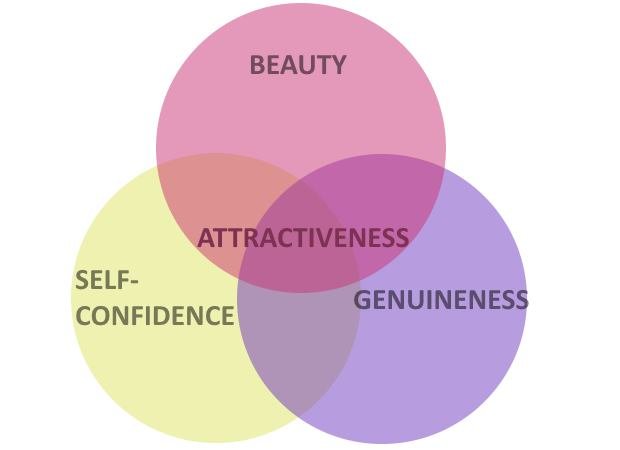
Confidence = you're not seeking constant validation. You make eye contact. You don't apologize for your appearance. You move without checking if people are watching. You wear what fits, not what you think should work. You're present in conversation, not mentally critiquing your reflection.
None of this requires you to feel confident. It requires you to behave as if you're not the main character in a drama about your looks. And behavior, repeated, becomes real confidence.
So the play isn't "fake it till you make it." It's: spend 5 minutes on grooming, 30 seconds choosing clothes that fit, 10 seconds making eye contact, and 0 seconds obsessing over features you can't change. That is what confidence looks like.
FAQ
What actually makes someone conventionally attractive?
Clear skin, symmetry-ish features, health (energy, not thinness), good grooming, and confidence. That's across cultures and demographics — though individual preference varies wildly. Someone's type matters more than objective rating. You'll be hot to your type.
Why do I look bad in photos but good in mirrors?
Mirrors are flipped, curved, and you control your expression. Phones distort with lens width. Bad lighting tanks anyone. Take photos in natural light, outdoors if possible, and stop comparing selfies (worst angle + harsh light) to mirror selfies (best angle + adjusted expression).
Is mewing / jaw exercises / canthal tilt study actually worth the time?
Soft-maxxing (grooming, clothes, sleep, skincare) pays off in weeks and costs almost nothing. Hard-maxxing (surgery, orthodontia, extreme diet) takes years and thousands of dollars for maybe 10–15% gain. If you enjoy the research, fine — but most people's returns cap out fast. Spend the energy on sleep + skincare + fit clothes instead. Better ROI.
How much of attractiveness is genetic?
Roughly 20–30%. The rest is health, grooming, confidence, lighting, and the observer's personal taste. That means 70–80% is in your hands. You probably underestimate this.
I feel attractive some days and ugly others. What's going on?
You're not changing. Your sleep, lighting, clothes, and mood are changing. Two hours of better sleep = clearer eyes, less slouching, more energy. Golden-hour light vs. fluorescent = two different faces. A shirt that fits vs. one that doesn't = massive shift in how you carry yourself. Same face, different signal.
Is the "average attractiveness" quiz actually useful?
No, because "average" isn't a number — it's a distribution. You are someone's type. What the quiz can tell you is whether your self-image is wildly off from how you actually present, whether you're in a comparison trap, or whether you're fixating on one variable instead of the grooming/health things that actually move the needle. That's useful.
The Real Answer
You're asking "how attractive am I" because you want permission to stop obsessing. Here it is: You're probably in the normal-to-good range if you're eating, sleeping, and not actively neglecting hygiene. You could measurably improve in 6 weeks with better skincare and clothes that fit. You can't meaningfully change your face shape with mouth posture. Those are the facts.
But the real answer isn't a number. It's a choice: you can either spend the next year optimizing facial geometry you can't control, or spend the next 6 weeks on sleep, skin, and style, then stop thinking about it and get a life.
One of those will actually make you more attractive. It's not the one that sounds impressive on the internet.
Take the appearance confidence quiz to see how your self-image stacks up—and get a personalized read on where the gap between you and your reflection actually is.
This is a self-reflection tool, not medical or mental-health advice. If intrusive thoughts about appearance are affecting your wellbeing, talking to a therapist is worth the investment.
Want a personalized read on this? Find Your Real Attractiveness Baseline — a few minutes, instant results.
Related Articles

You Get Compliments… So Why Do You Still Feel Insecure? The “Attractiveness Paradox” Explained
If compliments don’t make you feel better, you’re not broken—you’re stuck in a predictable psychology loop. Here’s how it works and how to fix it.
The Confidence Tax: Why Being Attractive Can Cost You Peace of Mind
When looking good becomes a responsibility instead of a benefit, confidence turns fragile. Here’s the science—and how to reclaim stable self-worth.

The Compliment Hangover: Why Praise About Your Looks Can Make You Feel Less Confident
If compliments don’t land—or they make you feel anxious—you may be stuck on the validation treadmill. Here’s what’s happening and how to break the loop.