
Is It Insomnia or Anxiety? Understanding the Racing-Mind-at-Night Loop
Dr. Lena Okafor
6/11/2026
Is It Insomnia or Anxiety? Understanding the Racing-Mind-at-Night Loop
TL;DR
- Insomnia and anxiety are deeply linked: your anxious brain keeps you awake, and sleep loss makes anxiety worse the next day
- The vicious cycle works like this: racing thoughts → sleep loss → next-day exhaustion and hypervigilance → more anxiety → worse sleep
- The key distinction: anxiety insomnia means your nervous system won't "off-switch" at night, even when you're exhausted; pure insomnia means sleep onset or maintenance problems without the racing-thought component
- Breaking the loop requires addressing both at once: calming your nervous system and rebuilding sleep, not treating them separately
- A self-assessment quiz can help you pinpoint which is the primary driver so you can target the right intervention first
What You Actually Experience: The Tired-but-Wired Paradox
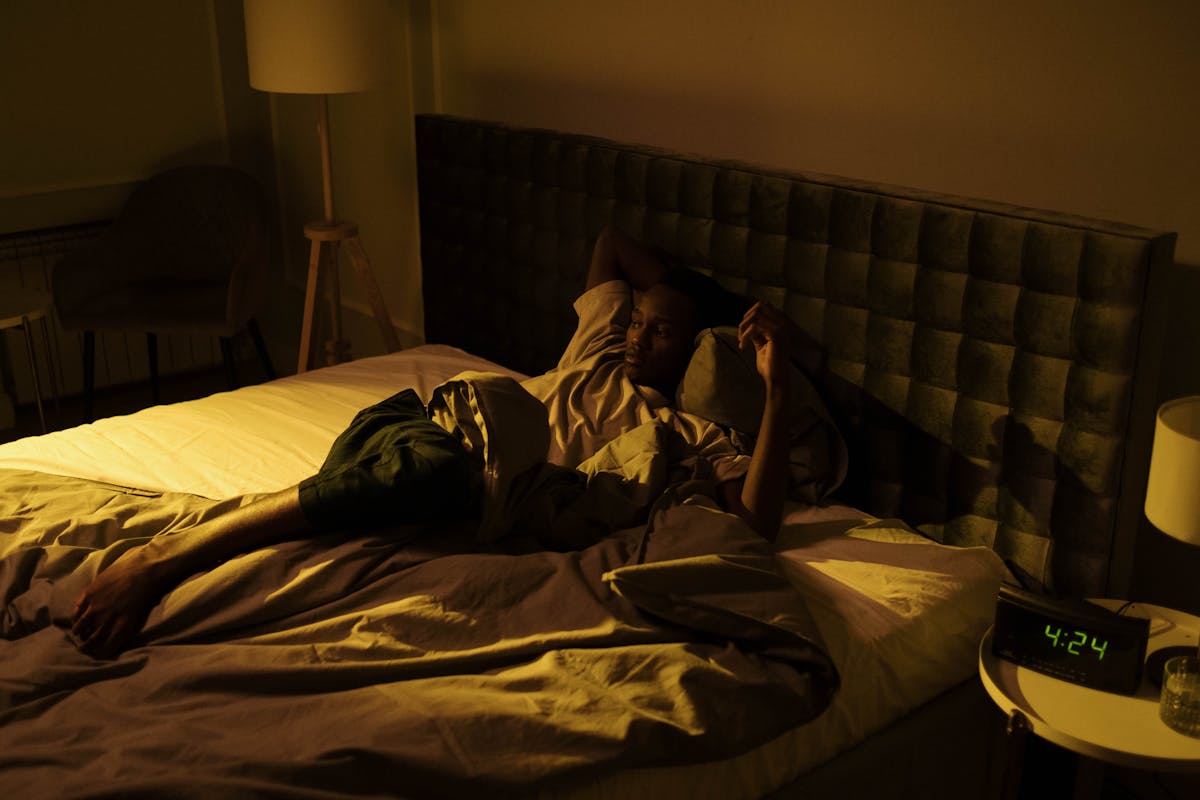
You're lying in bed. Your body is physically exhausted—you've been awake since 5 AM, you can barely keep your eyes open at 9 PM. But the moment your head hits the pillow, your brain turns on like a light switch. Suddenly you're running through tomorrow's presentation, replaying an awkward text exchange from this morning, catastrophizing about money, or cycling through the same three worries you've already solved (in theory) five times today.
This isn't insomnia in the classical sense (though it often gets diagnosed that way). This is your nervous system staying locked in "on" mode, even when rest-seeking behavior is present. Careica Health identifies this exact experience—"tired but can't sleep" ranks among the top sleep-related Google searches—and it's the hallmark signature of anxiety driving sleep loss.
But here's the cruel part: that sleepless night? It makes your anxiety worse the next day. Neurologically, sleep deprivation impairs your prefrontal cortex (the brain's "rational" region) and amplifies amygdala reactivity (the threat-detection center). Translation: you're more emotionally reactive, less able to regulate worry, and more likely to catastrophize on two hours of sleep than on eight. So the cycle tightens.
The Insomnia-Anxiety Feedback Loop (How It Gets Worse)
It's not that insomnia causes anxiety or anxiety causes insomnia. They amplify each other in a loop:
Night 1: Racing Thoughts Block Sleep
Your mind starts spinning with worries (finances, health, relationships, work). You try to sleep but can't quiet your thoughts. You get, say, 4 hours.
Day 2: Sleep Deprivation Amplifies Worry
You wake up exhausted, emotionally raw, and with a lower threshold for stress. Small problems feel catastrophic. You feel hypervigilant. Your brain is now more prone to anxiety rumination, not less.
Night 2: Anticipatory Anxiety About Sleep Itself
Now you're anxious about sleep. "Will I sleep tonight? Last night was terrible. I can't afford to lose sleep again." This sleep anxiety—fear of insomnia itself—becomes its own blocker. You're wound up before you even get into bed, guaranteeing another restless night.
Nights 3+: The Cycle Hardens
A pattern forms. Your brain learns: "Bedtime = threat time." Your nervous system anticipates sleep loss and stays defensive. You might get some fragmented sleep—but not enough to reset your anxiety. The system is now stuck.
Why This Loop Is So Hard to Break
If you treat only the anxiety (with medications or coping strategies), but don't improve sleep quality, your nervous system stays in threat-response mode because it's literally underfueled by rest. If you treat only the insomnia (with sleep meds or sleep hygiene), but don't address the racing-thought component, the underlying anxiety keeps the nervous system activated and insomnia bounces back the moment you stop the intervention.
This is why both need to be addressed in parallel.
How to Tell Them Apart: The Key Distinction
Here's a practical way to separate them:
Anxiety-Driven Insomnia (Racing Mind)
- Your mind is actively busy: you're thinking, worrying, replaying, planning
- You're aware of your thoughts keeping you awake (not just "can't fall asleep," but "can't stop thinking")
- Your body might feel wired (tension, restlessness), even though you're tired
- You fall asleep eventually, but only after an hour or more of mental spinning (delayed sleep onset)
- You wake up and immediately feel your mind restart—no grogginess, just instant alertness and worry
- Sleep anxiety is present: you're worried about whether you'll sleep before you try
- Your anxiety shows up in other contexts too: during work, social situations, decision-making
Primary Insomnia (Sleep Disorder)
- Your body won't settle; you feel restless, uncomfortable, physically activating
- You're not thinking excessively; you just can't drift off or can't stay asleep
- Even with a quiet mind, sleep doesn't come
- You might sleep OK for a few nights then have a terrible night, with no clear anxiety trigger
- Your anxiety is mainly about sleep, not a broader pattern
- Falling asleep was never really your problem; maintaining sleep (frequent waking) is
The Overlap
Most people with this problem have both: a baseline level of anxiety that's heightened (trait), plus sleep-specific anxiety (state) that worsens the condition. The racing mind is the anxiety; the fragmented sleep is the insomnia result.
Why Doctors Often Conflate Them
Insomnia and anxiety are so tightly linked that they share diagnostic criteria and the same interventions. According to cognitive-behavioral therapy frameworks, insomnia and anxiety disorder co-occur in 40–50% of cases (research cited in sleep-medicine reviews). This overlap led the DSM-5 to clarify that insomnia can be a symptom of an anxiety disorder, not always a separate diagnosis.
But clinically, this matters: if your insomnia is secondary to anxiety, treating the anxiety (via therapy, medication, or both) often improves sleep. If your insomnia is primary (a standalone sleep disorder), anxiety treatment alone won't fully solve it.
The safest approach: acknowledge both are present and address them together. A combination of cognitive-behavioral therapy for insomnia (CBT-I) + anxiety-specific therapy (e.g., cognitive-behavioral therapy for anxiety, or exposure therapy for worry) is the gold standard.
Breaking the Loop: Where to Start
If you've identified that you're caught in the racing-mind-at-night cycle, here's the strategic order:
1. Address Sleep Environment & Routine First (This Buys You Data)
Even if anxiety is driving it, a calming sleep environment reduces stimulus for arousal:
- Consistent bedtime / wake time, even on weekends
- No screens 1 hour before bed (blue light delays melatonin)
- Cool, dark, quiet room
- No caffeine after 2 PM
Why start here? Because if you do this for 2 weeks and sleep still doesn't improve, you've ruled out low-hanging fruit and can focus on the nervous-system work.
2. Interrupt the Anxious Thought Cycle (Before Bed)
Techniques that work:
- Worry time (scheduled, not bedtime): Set aside 15 minutes earlier in the day to worry intentionally, then close the loop. This prevents rumination from hijacking bedtime.
- The "thought parking lot": Keep paper by your bed. If a worry pops up, write it down and tell your brain, "This is handled tomorrow." The act of externalizing reduces the compulsion to loop.
- Breathing / grounding: 4-7-8 breathing (inhale 4 counts, hold 7, exhale 8) activates the parasympathetic nervous system. Box breathing (4-4-4-4) also works. Do this for 5 minutes before bed.
- Avoid the "trying to sleep" trap: If you're in bed and thoughts are racing after 20 minutes, get up. Read something boring, or do a gentle activity in low light, then return to bed. Never stay in bed "white-knuckling" sleep.
3. Consider Professional Support
If the loop is persistent (>2 weeks despite sleep hygiene), reaching out to a therapist or doctor is warranted. Options:
- CBT-I (Cognitive-Behavioral Therapy for Insomnia): The gold standard for insomnia, works even when anxiety is a driver
- Anxiety-focused therapy: If anxiety is broader, CBT for anxiety or acceptance-commitment therapy (ACT) can help
- Medication (if indicated): Short-term sleep medication + anxiety medication, but not as a permanent solution without behavior change
This is a self-assessment tool, not medical advice. If you're experiencing persistent sleep loss or anxiety, consult a healthcare provider to rule out underlying conditions and get personalized guidance.
FAQ: Real Questions People Ask About Insomnia & Anxiety
Can anxiety cause insomnia?
Yes. Anxiety activates your sympathetic nervous system (fight-or-flight), which is the opposite of the parasympathetic state needed for sleep. Racing thoughts, physical tension, and hypervigilance all block sleep onset. However, not all insomnia is caused by anxiety—some is purely a sleep-regulation disorder—so it's important to assess which is primary.
Can lack of sleep cause anxiety?
Absolutely. Sleep deprivation impairs emotional regulation (via the prefrontal cortex) and amplifies threat-detection (via the amygdala). Even people without baseline anxiety become more anxious, irritable, and catastrophic after a night or two of poor sleep. Chronic sleep loss compounds this, creating a vicious cycle.
What's the difference between insomnia and just bad sleep?
Insomnia is a persistent pattern: difficulty falling asleep (delayed onset), staying asleep (fragmented), or returning to sleep (early waking), occurring at least 3 nights per week for at least 3 months, and causing daytime impairment (fatigue, mood, concentration). A few bad nights due to stress or travel isn't insomnia; it's a transient sleep disruption. Insomnia is the pattern.
Why do I feel anxious at night but not during the day?
Night amplifies anxiety because: (1) You're alone with your thoughts without external stimuli to ground you; (2) Your body's natural cortisol dip at night can leave you emotionally unregulated; (3) Anticipatory anxiety about sleep itself (sleep anxiety) kicks in; (4) You're reviewing the day and planning tomorrow, which can trigger rumination; (5) Your nervous system recognizes bedtime as "threat time" (learned conditioning) if you've had many nights of sleep loss. Daytime distractions (work, people, activities) suppress anxiety through stimulation; bedtime removes that buffer.
Is it OK to take sleep medication if I have anxiety insomnia?
It depends. Short-term sleep medication (2–4 weeks) can help break the acute cycle by giving your nervous system a few nights of actual sleep, which resets some of the damage. However, medication alone without addressing the underlying anxiety and thought patterns usually doesn't stick long-term—you'll need to develop non-medication strategies in parallel. The combination of CBT-I + short-term medication (if indicated by a doctor) is more durable than either alone. Always consult a healthcare provider before starting or stopping any medication.
Why does my anxiety/insomnia get worse in seasons or after stressful events?
Because anxiety and sleep are both highly responsive to stress, circadian rhythm changes (seasonal light shifts), and life circumstances. Major life stress (work deadlines, relationship changes, health concerns) naturally increases both anxiety and sleep fragmentation. If the stressor resolves, sleep usually improves. If stress becomes chronic, your nervous system can stay stuck in threat mode, and the insomnia persists even after the stressor passes. This is when professional intervention becomes important.
What Your Quiz Result Means
Our sleep assessment is designed to help you understand whether racing thoughts (anxiety), sleep fragmentation (insomnia), or both are your primary drivers. Your result will show:
- Your anxiety-load score: How much racing thoughts and worry are blocking your sleep
- Your insomnia-severity score: How disrupted your sleep architecture is (onset, maintenance, quality)
- The feedback loop you're in: Which one is probably amplifying the other
- Immediate next steps: Targeted strategies to address your pattern, not generic sleep advice
Knowing which lever to pull first—anxiety or sleep—makes the difference between spinning your wheels and actually breaking the cycle.
Take the Sleep & Anxiety Assessment →
The Takeaway
Insomnia and anxiety aren't separate problems when they're feeding each other at night. The racing mind keeps you awake; sleep loss amplifies anxiety; you become anxious about sleep itself; the cycle hardens. The way out isn't to pick one and treat it in isolation. It's to interrupt both simultaneously: calm your nervous system and rebuild your sleep, together.
A structured self-assessment can show you which is the primary driver in your specific pattern, so you can target your effort where it'll have the most impact. And if the cycle has been going on for weeks, that's the sign to bring in professional support—a therapist, doctor, or both.
Sleep is not a luxury. It's the foundation everything else builds on. You're not broken for struggling with this; the loop is just strong. But it can break.
Ready to assess your sleep pattern? Take the quiz →
Want a personalized read on this? Take the Sleep Assessment — a few minutes, instant results.
Related Articles

Why Am I Always Bloated? 9 Common Causes (and How to Find Yours)
If you're bloated by mid-afternoon every single day, it's usually not 'just what you ate.' Here are the 9 real causes of chronic bloating and how to pinpoint yours.
Am I Sleep Deprived: 5 Hidden Signs You're Running on Empty
You sleep 8 hours and wake exhausted. Your brain feels foggy. You're snapping at people. These aren't laziness—they're signs your body is running a sleep debt you probably don't realize.

Am I Tired All the Time? Why You're Exhausted and How to Know If It's Your Hormones
You sleep 8 hours and wake up feeling like you got hit by a truck. Here's what's actually going on—and how to tell if it's your hormones, stress, or something else.