
Am I Sleep Deprived: 5 Hidden Signs You're Running on Empty
Dr. Lena Okafor
6/8/2026
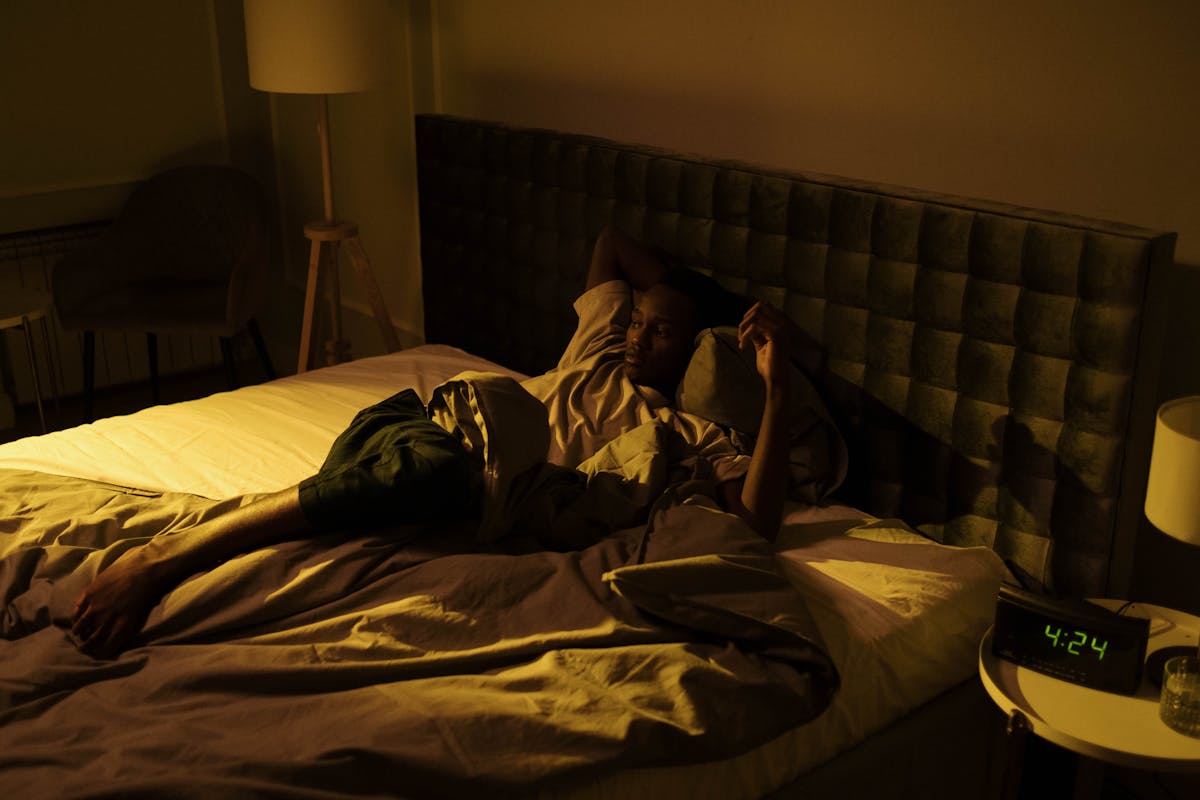
Am I Sleep Deprived Quiz: 5 Hidden Signs You're Running on Empty
This article is for informational purposes only and does not constitute medical advice. If you experience chronic insomnia, suspected sleep apnea, or daytime impairment affecting your safety or health, please consult a qualified healthcare provider.
TL;DR
- Sleep deprivation doesn't always feel like tired—it feels like irritability, constant food cravings, and microsleeps you don't remember
- You can sleep 8 hours and still be sleep-deprived if your sleep quality is shot by stress, wake-ups, or circadian misalignment
- "Tired but wired" (exhausted + anxious at bedtime) is a telltale sign your nervous system is stuck in overdrive
- Most sleep-deprived people normalize these signs instead of naming them
- A quiz that screens for sleep debt—not just "do you get 8 hours"—is the fastest way to tell if rest is what you actually need
What Sleep Deprivation Actually Feels Like (Spoiler: Not Always Sleepy)
You've probably imagined sleep deprivation as a zombie shuffle—heavy eyelids, nodding off at your desk. But the most insidious part of sleep debt is that your body adapts to it. You stop feeling tired and start feeling like yourself: irritable, foggy, hungry all the time, and vaguely exhausted in a way you've learned to ignore.
Here's the reality: "Tired but can't sleep" is among the top sleep-related Google searches, according to Careica Health. That phrase—tired but wired—captures the broken paradox that defines modern sleep deprivation. You're exhausted, but your nervous system is stuck in "on" because your body has been running on fumes for weeks.
And you're not alone. According to CDC NCHS Data Brief #559 (2024), 30.5% of U.S. adults sleep fewer than 7 hours per night—and only 54.8% report waking up well-rested. That means roughly one in two adults is starting each day already behind.
Sleep deprivation isn't a character flaw. It's your nervous system telling you it's been in threat-mode too long.
5 Hidden Signs You're Actually Sleep Deprived (The Ones You're Probably Ignoring)
1. Microsleeps You Don't Remember
You're reading an email. Your brain checks out for 3 seconds. You snap back and re-read the same sentence. You didn't "fall asleep"—it didn't feel like sleep. It felt like a moment of being underwater, then surfacing.
That's a microsleep. Your brain is so desperate for rest that it's stealing 1–10 second power naps while you're technically awake. They're invisible to you, which is why sleep-deprived people swear they're getting plenty of sleep—they don't notice the lost time.
Microsleeps happen when your sleep debt is real, not because you "didn't sleep enough last night," but because your total accumulated sleep pressure is too high. Driving on the highway and suddenly realizing 20 minutes vanished? That's a sign.
2. Irritability That Feels Like Everyone Else Is Annoying
You snap at your partner for something minor. You're angry at traffic. A work email feels like a personal attack. Then later, you realize: "That wasn't actually that bad. Why was I so mad?"
That's sleep deprivation rewriting your emotional thermostat. Sleep loss literally weakens your prefrontal cortex—the part that regulates patience and emotional control—while it amplifies your amygdala, the threat-detection alarm. In plain English: you become hypersensitive to small frustrations.
The National Heart, Lung, and Blood Institute states that sleep-deficient people "may feel angry and impulsive, have mood swings, feel sad or depressed, or lack motivation"—not because they have a mood disorder, but because sleep is what keeps the emotional architecture functioning. You're not being dramatic. Your brain is just running without the cognitive resources to regulate how you feel. When you sleep better, the same annoyances bounce off you.
3. Constant Food Cravings (Especially Sugar and Carbs)
You're not hungry—your body is energy-desperate. Sleep-deprived brains crave quick calories because they're running a deficit. When you don't sleep, your body releases more ghrelin (the hunger hormone) and less leptin (the satiety hormone). The result: you feel hungrier, crave sugar specifically, and eat more even when you're not actually hungry.
You reach for coffee and a muffin at 3 PM. You're not lazy; you're your brain's attempt to self-medicate energy loss with the fastest fuel available.
If you're noticing unusual cravings + fatigue together, sleep is probably the root, not willpower.
4. Brain Fog That Feels Like You're Underwater
You can't remember why you walked into a room. A word that should be easy is stuck on the tip of your tongue. You're re-reading paragraphs because they didn't register the first time. You feel slow.
This is sleep-loss-induced cognitive dulling. Your working memory—the RAM of your brain—shrinks without sleep. You're not getting dumber; your brain is just operating on reduced processing power. Most people attribute this to age or "getting dumb," when it's actually a screaming signal from your body that it needs rest.
The science behind this is not subtle. A 2024 NHLBI-funded study published in Neurology followed over 500 adults for 11 years and found that people with consistently fragmented sleep in their 30s and 40s scored lower on memory and thinking tests a decade later—independent of how many total hours they slept. The quality of your sleep, not just the quantity, shapes your cognitive future.
5. Inability to Regulate Your Mood or Anxiety (Especially at Night)
You've heard the Twitter joke: "me: time to sleep / anxiety: time for my one-woman show." That's real. Sleep-deprived nervous systems can't downregulate anxiety because the systems that quiet fear are the first things sleep loss breaks.
You lie in bed, and your mind spirals. Work problems feel catastrophic. A small mistake becomes evidence you're failing. You're not catastrophizing because you're anxious; you're anxious because your brain's emotional-regulation circuits are offline.
This creates a vicious loop: poor sleep → anxiety → can't fall asleep → worse sleep. The way out isn't "think more positively." It's getting actual rest.
The Sleep Debt Mechanic Most People Don't Understand
Here's the biology your exhaustion is running on.
Every hour you're awake, a compound called adenosine builds up in your brain, creating what sleep researchers call "sleep pressure." Sleep clears it. This homeostatic drive—known as Process S in Borbély's two-process model of sleep regulation—is one of the foundational frameworks in sleep medicine. When you don't sleep enough, the debt accumulates.
Caffeine doesn't repay it; it only blocks the adenosine signal temporarily. The debt is still there when the coffee wears off. That's why many people are running on what feels like functional energy while carrying a significant neurological deficit—measurable in reaction time, working memory, and immune response.
The immune cost is real. A 2021 PMC review on sleep deprivation and immune-related disease risk documents that even a single night of insufficient sleep can reduce natural killer cell activity—your immune system's frontline responders—to 72% of baseline. Sleep debt isn't just fatigue. It's your defenses going offline.
Matthew Walker, Professor of Neuroscience and Psychology at UC Berkeley and author of Why We Sleep, explains the debt framing this way: the cognitive damage from chronic short sleep—impaired recall, immune suppression, emotional dysregulation—accumulates over time and is not simply reversed by one long weekend of catch-up. The biology doesn't work like a bank overdraft you can zero out with a single deposit. Current clinical guidance focuses on consistent sufficient nightly sleep rather than catch-up strategies.
How You Ended Up Sleep-Deprived Without Realizing It
You probably sleep 7 to 8 hours a night. Your Fitbit says so. So why do you feel wrecked?
Duration is not the same as quality. You can log 8 hours and still be sleep-deprived if:
- You wake up 4–5 times a night (stress, partner snoring, baby, cortisol spikes). You don't remember the wake-ups, but your sleep is fragmented into 90-minute chunks instead of long, deep cycles.
- Your circadian rhythm is misaligned (you sleep 1–4 AM because of night-shift work or phone scrolling, but your body wants to be asleep 11 PM–7 AM). Sleeping at the "wrong" time means less deep sleep, even if duration looks fine.
- Your REM or deep-sleep percentage is low (you're in light sleep all night). A sleep tracker might show "7 hrs slept, 30 min deep sleep"—that's 4% deep sleep. Most people need 15–20%.
- You're under chronic stress (work, relationships, money). Your cortisol is elevated even during sleep, which means you're never fully restoring.
This last point matters more than most people realize. Sleep cycles are not uniform across the night. The first half of a full sleep window is dominated by deep, slow-wave sleep (N3)—physical repair, immune function, growth hormone release. The second half shifts toward REM-rich cycles, which are critical for emotional processing and memory integration. Walker explains that if you cut even 60–90 minutes off the end of your sleep window—going from 8 hours to 6.5—you don't lose those hours proportionally across all stages. You disproportionately lose REM. That's why a consistently early alarm can leave you emotionally flat or quick to irritate even when you feel like you "got enough sleep."
All of these create the paradox: 8 hours on paper, wrecked in reality.
That's why a quiz that asks about actual symptoms—not just "how many hours"—matters. The quiz should catch the hidden exhaustion, not trust your spreadsheet.
When You're Not Just Tired—You're Burned Out
There's a special flavor of sleep deprivation that comes from burnout. You're tired, but it's not the good tired that rest fixes. It's the numb tired.
From research on burnout patterns, the distinction is: Stress makes you feel overwhelmed; burnout makes you feel empty. Sleep deprivation can be part of both, but when combined with burnout, the fatigue has a particular hollowness to it—you sleep and still feel hollow.
If your tiredness comes with:
- Emotional numbness ("I don't care about things I used to love")
- A sense that rest doesn't fix it
- Dread about returning to work/life even after a weekend
...then sleep alone won't solve it. You might need a bigger change. But a sleep quiz can still be the starting point to rule out whether sleep deprivation is compounding the burnout.
FAQ: Real Questions Sleep-Deprived People Ask
Can you be sleep-deprived and not feel tired?
Yes, absolutely. Sleep deprivation is sneaky because your body adapts. You stop feeling tired and instead feel irritable, foggy, and hungry. Your baseline shifts. Some of the most sleep-deprived people are the ones who "feel fine" because they've normalized the fog.
How much sleep do I actually need?
Most adults function best on 7–9 hours, but the sweet spot varies. Some people genuinely need 6; others need 10. The question isn't "How many hours should I sleep?" but "How many hours do I need to feel alert and regulated?" If you feel foggy, irritable, or craving sugar after 7 hours, you need more.
Is "tired but wired" a sign I have insomnia or sleep deprivation?
Both, potentially. "Tired but wired" usually means your nervous system is stuck in high alert while your body is exhausted. This happens with chronic stress, anxiety, or yes, sleep deprivation. Your nervous system learned to stay "on" to protect you, and it won't relax even when you're trying to sleep. A sleep-quality quiz will help clarify whether it's primary insomnia or anxiety-driven sleep loss.
If I sleep 8 hours but wake up exhausted, what's wrong?
Could be sleep fragmentation (waking 4–5 times without remembering), low deep-sleep percentage, circadian misalignment, sleep apnea, or high stress that keeps you in light sleep. This is why asking "How many hours?" misses the real problem. A quiz that screens for quality matters more than duration.
Can sleep deprivation cause anxiety, or does anxiety cause sleep deprivation?
It's bidirectional. Anxiety disrupts sleep ("my brain turns on at bedtime"). Sleep deprivation weakens your anxiety-regulation circuits, making you more anxious the next day. The loop perpetuates. Breaking it requires addressing both—better sleep and nervous-system regulation (exercise, breathing, reducing caffeine).
Is it normal to need coffee just to function?
Not really. If you need caffeine to be alert, it's often a sign you're sleep-deprived or circadian-misaligned. Caffeine is a bandage, not a fix—it blocks the adenosine signal without clearing the underlying debt. Most people who consistently sleep well find they need far less coffee, or none at all.
The Hidden Cost of Normalizing Sleep Deprivation
We live in a culture that treats sleep deprivation like a badge of honor. "I'll sleep when I'm dead." "I only need 5 hours." "Tired is the new normal."
What's actually normal: sleeping enough that you feel good. Sleep deprivation isn't a personality trait; it's a signal that something is out of balance.
The longer you run on a sleep debt:
- Your immune system degrades (more colds, longer recovery—NK cell activity measurably drops after even one short night)
- Your metabolism shifts (easier weight gain, harder time losing weight)
- Your emotional resilience collapses (small things feel huge)
- Your decision-making weakens (you're more impulsive, reactive)
- Your risk of depression and anxiety rises
The cognitive cost compounds quietly. That NHLBI midlife study is a useful anchor: people didn't notice the cognitive erosion happening in their 30s and 40s—they just felt tired. The tests a decade later told the story their feelings couldn't.
This isn't doom-mongering. It's biology. Sleep isn't a luxury. It's the infrastructure your brain and body run on.
If you're reading this and thinking, "Yeah, that's me"—that's the first sign. The second step is taking a quiz that actually captures what sleep deprivation feels like, not just how many hours you claim to sleep.
More Quizzes You Might Find Useful
If you identified with the burnout angle above, the Burnout Score Quiz screens for emotional exhaustion and depletion patterns separately from pure sleep debt.
Next Step: Find Out Where You Actually Stand
You probably came here because something felt off. Maybe you're exhausted but can't name why. Maybe you're irritable and chalking it up to life being hard. Maybe you're eating like it's your job and wondering what's wrong with your willpower.
These are all signs. And the fastest way to know if sleep debt is the culprit is to take a real sleep-deprivation screening—one that asks about the hidden signs, not just "Do you get 8 hours?"
Take the Sleep Deprivation Quiz and find out if you're actually as rested as you think.
This article is for informational purposes only and does not constitute medical advice. It is not a substitute for professional medical evaluation or treatment. If you suspect chronic insomnia, sleep apnea, or another sleep disorder, please consult a qualified healthcare provider or sleep specialist.
Related Articles

Why Am I Always Bloated? 9 Common Causes (and How to Find Yours)
If you're bloated by mid-afternoon every single day, it's usually not 'just what you ate.' Here are the 9 real causes of chronic bloating and how to pinpoint yours.

Adrenal Fatigue: What's Real, What's Myth (HPA Axis Explained)
Adrenal fatigue isn't a recognized medical diagnosis—but HPA axis dysfunction and chronic stress-induced exhaustion very much are. Here's how to tell the difference and what actually works.